Short-term Visitors at NIMBioS in 2013
Short-term visitors to NIMBioS are supported for periods from one week to a month to assist their efforts in carrying out research that conforms to the mission of NIMBIoS to foster research at the interface between mathematics and biology.
Benito Chen (Math, Univ. of Texas Arlington) and
Maria Leite (Math & Statistics, Univ. of Toledo)
Project Title: Coupling discrete fire and insect outbreak disturbances in forests
Benito Chen and Maria Leite are collaborating on a project to develop a model to study the effect of fires on the pine bark beetle and pine plantations.
Visit Dates: May 18-25, 2013
Tom Currie (Human Evolutionary Ecology Research Group, Univ. College London)
Project Title: The evolution of social complexity: mathematical models of competing theories
Tom Currie is collaborating with Sergey Gavrilets to construct a mathematical model to assess alternative theories of the evolution of social complexity.
Visit Dates: April 14-17, 2013
NIMBioS seminar: War and space: Simulating the evolution of old world complex societies
Karoun Bagamian (Geography/Emerging Pathogens Institute, Univ. of Florida),
Mac Hyman, Math/Center for Computational Sciences, Tulane Univ., and
Carrie Manore (Math/Center for Computational Sciences, Tulane Univ.)
Project Title: The evolution of social complexity: mathematical models of competing theories
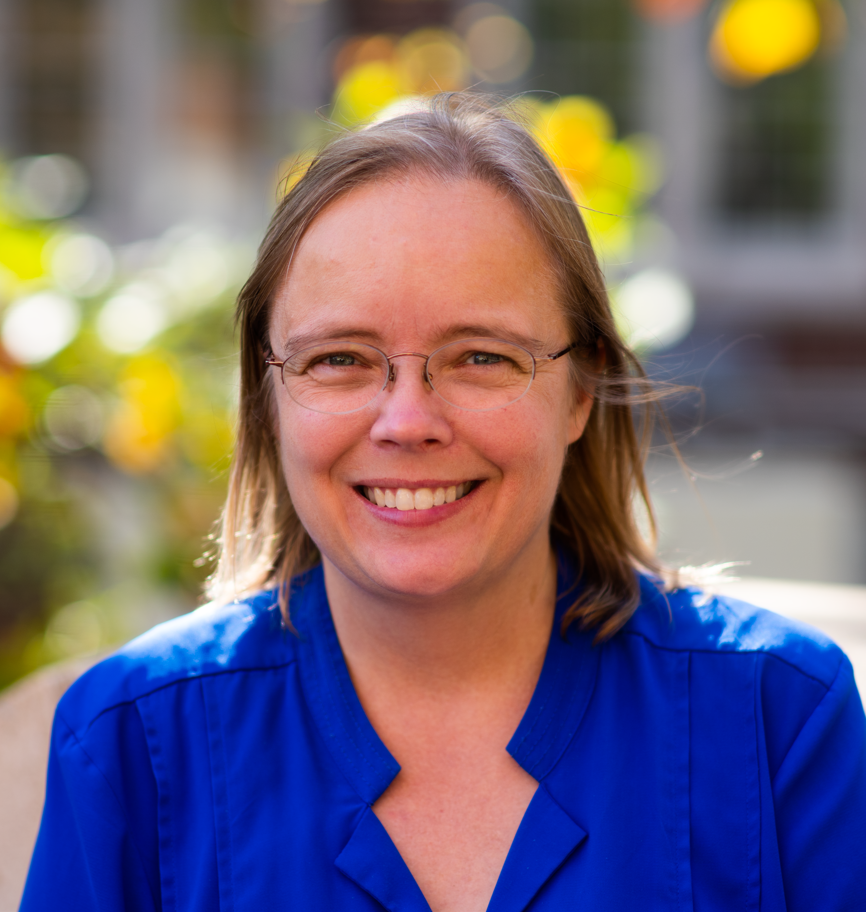
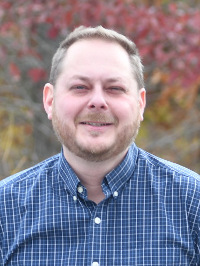
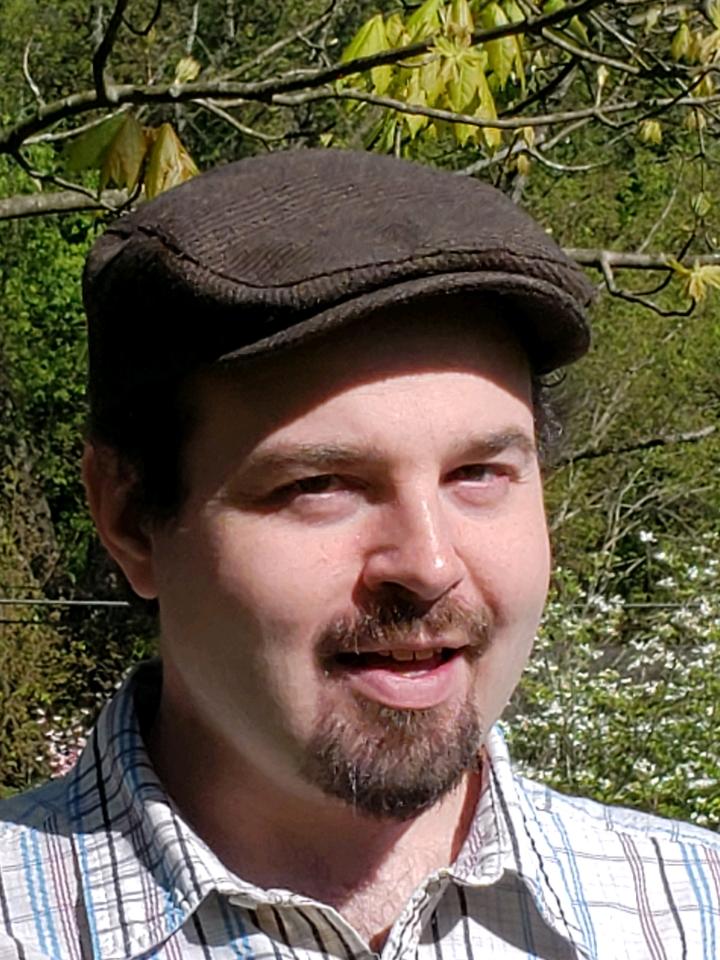
Mac Hyman (pictured left), Carrie Manore (center) and Karoun Bagamian (right) are collaborating on a project to adapt an agent-based model for deermouse behavior and hantavirus transmission.
Visit Dates: April 10-13, 2013
Lisa Sattenspiel (Anthropology, Univ. of Missouri, Columbia) and
Alan Swedlund (Anthropology, Univ. of Massachusetts).
Project Title: Modeling pre-Columbian demographic processes in the Long House Valley, AZ
Lisa Sattenspiel (pictured left) and Alan Swedlund (right) gave a seminar talk and collaborated to develop model structures for integrating population processes and environmental constraints at both household and individual levels, consider role of infectious disease in population change, and develop possible working group/workshop request dealing with these topics related to the Long House Valley project.
Visit Dates: April 10-13, 2013
NIMBioS seminar: Modeling the demography of a pre-Columbian Southwest US population: The Artificial Long House Valley (ALHV) project
Gary An
(Surgery, Univ. of Chicago School of Medicine),
Reinhard Laubenbacher
(Virginia Bioinformatics Institute, Virginia Tech), and
René Salinas
(Mathematical Sciences, Appalachian State Univ.)
Project Title: Optimal control methods for agent-based models
Gary An (pictured left), Reinhard Laubenbacher (center) and René Salinas
are collaborating with NIMBioS Sabbatical Fellow David Gurarie (far right), Suzanne Lenhart, Louis Gross and Andrew Kanarek on projects related to the Working Group on Optimal Control of
Agent-based Models.
Visit Dates: April 1-3, 2013
Ludek Berec (Theoretical Ecology, Institute of Entomology, Biology Centre, Academy of Sciences of the Czech Rep.)
Ludek Berec visited with NIMBioS postdoctoral fellows and gave a seminar as a NIMBioS Postdoctoral Fellows Invited Distinguished Visitor.
Visit Dates: February 25-28, 2013
NIMBioS seminar: Allee effects and pest control
Kamuela Yong (School of Mathematics & Statistical Sciences, Arizona State Univ.)
Kamuela Yong gave a seminar talk and visited with faculty and postdoctoral fellows to discuss agent-based models for vector-borne diseases and to discuss ideas about modeling biodiversity in river systems.
Visit Dates: February 21-22, 2013
NIMBioS seminar: Estimating biting rates of triatomine on preferred sylvatic hosts in overlapping vector-host cycles
Philip Maini (Centre for Mathematical Biology, Mathematical Institute, Univ. of Oxford)
Philip Maini visited with NIMBioS postdoctoral fellows.
Visit Dates: February 8-9, 2013
Helene Muller-Landau (Center for Tropical Forest Science, Global Forest Carbon Research Initiative, Smithsonian Tropical Research Institute)
Helene Muller-Landau visited with NIMBioS postdoctoral fellows and gave a seminar as a NIMBioS Postdoctoral Fellows Invited Distinguished Visitor.
Visit Dates: January 28-31, 2013
NIMBioS seminar: Species Coexistence and Spatial Patterns in Plant Communities
Kailin Kroetz (Resource Economics & Policy Lab at UC Davis)
Project Title: Direct democracy's role in species conservation
Kailin is collaborating with Paul Armsworth
on a project to compare the effectiveness of conservation strategies that employ more democratic methods of control versus those that focus on a more centralized, top-down approach.
Visit Dates: January 23-28, 2013
Dan Blumstein (Ecology & Evolutionary Biology, UCLA)
Project Title: The relationship between group size and individual distinctiveness in vocalizations of songbirds
Dan Blumstein (center) is collaborating with NIMBioS Postdoctoral Fellows Arik Kershenbaum (left) and Amiyaal Ilany (right), in addition to UT Associate Professor of Psychology Todd Freeberg, on a project to explore the relationship between group size and individual distinctiveness in vocalizations of songbirds.
Visit Dates: January 15-18, 2013
NIMBioS seminar: The sound of fear: A journey from marmot meadows to Hollywood
Visitors work on-site at NIMBioS and may link the visit with a Working Group or other activity at NIMBioS. Visitors receive reimbursement for travel and housing expenses as well as a per diem.
Applications can include any type of interdisciplinary synthesis project, but NIMBioS particularly welcomes collaborative projects. Such collaborations might involve NIMBioS resident researchers or staff or local researchers; joint applications from two or more researchers to spend time together at NIMBioS; or applications from participants in other NIMBioS activities to work on their project with NIMBioS computational science staff.
Applications are considered four times a year, with deadlines on March 1, June 1, September 1, and December 1. Applications are evaluated in terms of both the scientific value of the project and the qualifications of the applicant. Particular priority is given to students and junior researchers.
For more information about short-term visits and how to apply, click here.
Visitor Archive: