| Description | Participants | Summaries | Products | Feature |
|---|
Archived NIMBioS Working Group
SPIDER
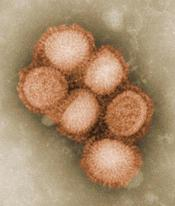
Topic: Working Group for Synthesizing and Predicting Infectious Disease while Accounting for Endogenous Risk (SPIDER)
Organizers:
Eli Fenichel (Arizona State Univ., School of Life Sciences)
Carlos Castillo-Chavez (Arizona State Univ., Dept. of Mathematics and Statistics)
Peter Daszak (Consortium for Conservation Medicine, New York, NY)
Rick Horan (Michigan State Univ., Dept. of Agricultural, Food, and Resource Economics)
Charles Perrings (Arizona State Univ., School of Life Sciences)
Meeting dates: June 7-9, 2009; November 9-11, 2009; May 16-18, 2011
Objectives: There is increasing interest in modeling risks associated with emerging infectious diseases (EIDs). Most EIDs are zoonotic in nature (Jones et al. 2008), and many infect valuable livestock and wildlife resources (Daszak et al. 2000). Disease risks, like the risks associated with invasive species, are endogenous – a function of human decisions (Finnoff et al. 2005; Horan and Fenichel 2007). However, most current attempts to model EID risks treat risk as exogenous and intrinsic. This comes from implicitly assuming that the probability of an event and the human self-protection decisions are additively separable in the consequence function (Shogren and Crocker 1999). In order to successfully manage, predict, and develop surveillance strategies for new emerging diseases, it is imperative that the human decision making processes that influence disease risks are formally included in the decision process. Recent mathematical advances offer new opportunities to do so. The SPIDER Working Group will bring together disease ecologists, economists, and mathematicians to facilitate the development of predictive models both to forecast the risks associated with EIDs in humans, livestock, wildlife, and plants, and to assist in the development of risk management strategies.
This project will assemble a working group to develop lines of research, share results and techniques, and provide capacity to unify models.
Meeting Summaries
| Mtg # | Dates | Agenda | Summary | Photo | Evaluation |
|---|---|---|---|---|---|
| 1 | Jun 7-9, 2009 | Link | - | Report | |
| 2 | Nov 9-11, 2009 | Link | Link | Report | |
| 3 | Off-site | ||||
| 4 | May 16-18, 2011 | Link | Link | Report |
Meeting 1 Summary. The first meeting of the SPIDER Working Group facilitated increased work on feedbacks between human behavior and emerging infectious disease risk. The group is employing a network motif to organize research combined with cross-cutting themes. The network motif organizes research themes to within nodes (e.g., countries, regions, or localities), on edges or pathways between nodes, and as a complex system. Cross-cutting themes include uncertainty and learning and computational issues. Each sub-group is developing a working paper and material for a synthesis paper. The Working Group meets next in early November, where the group will address issues associated with connecting the different sub-groups for the synthesis paper, resolving technical difficulties, and computing results.
Meeting 2 Summary. At the second meeting of the SPIDER Working Group, Nov. 9-11, progress continued on merging human behavioral and infectious disease models to improve understanding of disease risk and to build better predictive models. The working group clarified its definition of "prediction" in terms of the group's objective, which is to build models that can predict disease risk under alternative management strategies and policies. The group has also identified a modeling framework that is applicable to local, regional, national, and international scales. Thus far, two SPIDER-related manuscripts have been accepted for publication, and at least two more are almost ready for submission.
Meeting 3 Summary. —
Meeting 4 Summary. The fourth and final meeting was divided into two main sections: modeling focusing on local infectious disease problems and modeling focusing on regional (or global) infectious disease problems, both considering endogenous human behavior and risk. Presentations by various participants included ideas about extending the framework developed in Fenichel et al. (2011), an article developed by the SPIDER group and published since our last meeting. The local section focused on explicitly incorporating learning and uncertainty and more fully developing the choice set of agents in order to increase epidemiological and economic realism. The region section focused on trade and travel responses to and effects on disease risk. The group spent time editing and discussing a working paper on this topic.
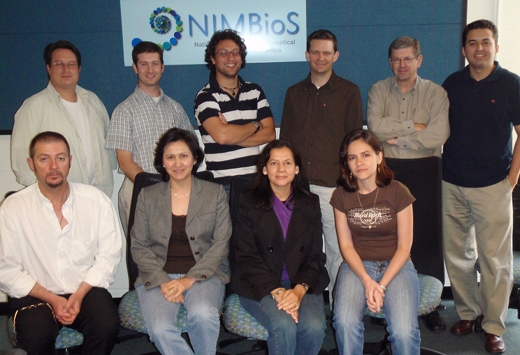 |
| Meeting 1 participants (Back row, L to R): Chris Jerde, Eli Fenichel, Graziano Ceddia, Michael Springborn, Charles Perrings and Gerardo Chowell-Puente; (Front, L to R): Garth Holloway, Christina Villalobos, Leticia Velazquez and Paula Gonzalez Parra; (Not pictured): Peter Daszak, Graham Hickling, David Finnoff, Lynn Garrett, Carlos Castillo-Chavez, Kate Smith, Salvatore di Falco, David Cook, and William Brock. |
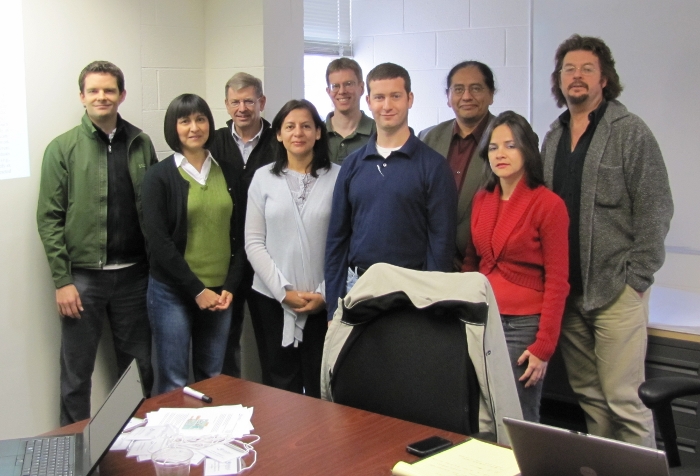 |
| Meeting 4 participants (Back row, L to R): Charles Perrings, Rick Horan, Carlos Castillo-Chavez, Garth Holloway; (Front row, L to R): Michael Springborn, Christina Villalobos, Leticia Velazquez, Eli Fenichel, Paula Gonzalez Parra |
NIMBioS Working Groups are chosen to focus on major scientific questions at the interface between biology and mathematics. NIMBioS is particularly interested in questions that integrate diverse fields, require synthesis at multiple scales, and/or make use of or require development of new mathematical/computational approaches. NIMBioS Working Groups are relatively small (up to 10 participants), focus on a well-defined topic, and have well-defined goals and metrics of success. Working Groups will meet up to 3 times over a two-year period, with each meeting lasting up to 2.5 days.
A goal of NIMBioS is to enhance the cadre of researchers capable of interdisciplinary efforts across mathematics and biology. As part of this goal, NIMBioS is committed to promoting diversity in all its activities. Diversity is considered in all its aspects, social and scientific, including gender, ethnicity, scientific field, career stage, geography and type of home institution. Questions regarding diversity issues should be directed to diversity@nimbios.org. You can read more about our Diversity Plan on our NIMBioS Policies web page. The NIMBioS building is fully handicapped accessible.
NIMBioS
1122 Volunteer Blvd., Suite 106
University of Tennessee
Knoxville,
TN 37996-3410
PH: (865) 974-9334
FAX: (865) 974-9461
Contact NIMBioS