| Description | Participants |
|---|
Computational Biology Curriculum Development Tutorial
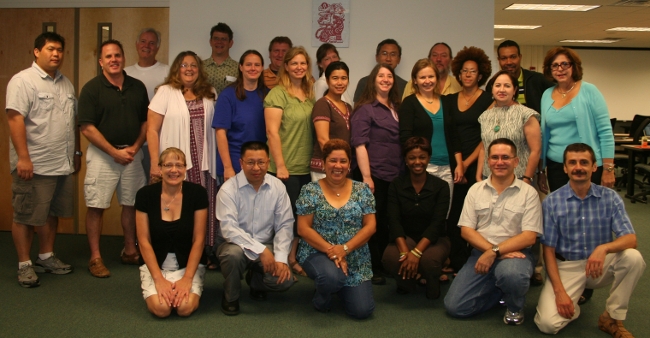
Topic: Computational Biology Curriculum Development Tutorial
Meeting dates: July 6-9, 2010
Location: NIMBioS at the University of Tennessee, Knoxville
Co-sponsors: NIMBioS, BioQUEST Curriculum Consortium, SCALE-IT, the University of Tennessee, and Oak Ridge National Laboratory.
Here's what participants said about their experience at the NIMBioS Tutorial: Computational Biology Curriculum Development.

Karla-Sue Marriott, Assistant Professor of Chemistry, Savannah State University
Rafael Tosado, Professor of Biochemistry and Molecular Biology, Inter American University of Puerto Rico
Objectives: This tutorial focused on helping graduate students and faculty develop curriculum resources and teaching approaches that reflect modern biological problem solving as well as engage students with the use of emerging computational tools and data. Participants explored the use of scientific data repositories, investigated online analysis and visualization tools, and utilized open source resources for scientific collaboration. The focus was on developing teaching units that apply quantitative biological problem solving strategies to real problems in medicine, epidemiology, forensics, agriculture and conservation.
This week long event was divided into three phases:
Phase I: Participants worked with existing curricular units to engage in research like learning activities.
Phase II: Everyone adapted and adopted existing resources to address their interests and teaching settings.
Phase III: Groups initiated longer-term development efforts that will form the basis for ongoing collaborations and curricular innovation.
Tutorial goals:
- Learn how to engage students with realistic scientific problems using rich datasets.
- Discover cyber-learning strategies for engaging students in cutting-edge science.
- Explore online data, visualization and analysis tools, and other resources to support student investigations.
- Learn and share strategies for supporting and assessing student investigations.
- Develop materials tailored for your classroom.
- Develop a scholarly approach to teaching and learning in undergraduate biology courses.
All of the materials used and developed as part of this tutorial will be available online.
A goal of NIMBioS is to enhance the cadre of researchers capable of interdisciplinary efforts across mathematics and biology. As part of this goal, NIMBioS is committed to promoting diversity in all its activities. Diversity is considered in all its aspects, social and scientific, including gender, ethnicity, scientific field, career stage, geography and type of home institution. Questions regarding diversity issues should be directed to diversity@nimbios.org. You can read more about our Diversity Plan on our NIMBioS Policies web page. The NIMBioS building is fully handicapped accessible.
NIMBioS
1122 Volunteer Blvd., Suite 106
University of Tennessee
Knoxville,
TN 37996-3410
PH: (865) 974-9334
FAX: (865) 974-9461
Contact NIMBioS