| Description | Participants | Agenda (pdf) | Products |
|---|
NIMBioS Tutorial
Graph Theory and Biological Networks
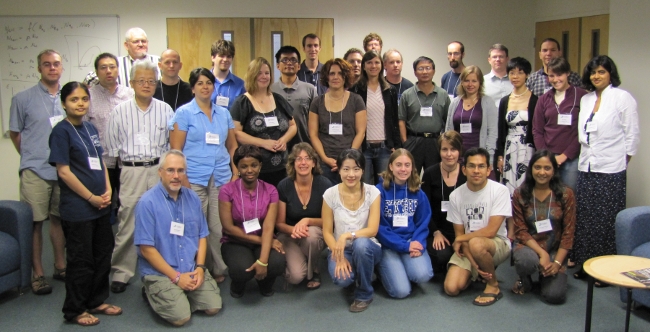
Topic: Graph Theory and Biological Networks Tutorial
Meeting dates: August 16-18, 2010
Location: NIMBioS at the University of Tennessee, Knoxville
Tutorial Leaders: Margaret Cozzens (Center for Discrete Mathematics & Theoretical Computer Science, Rutgers Univ.); Jo Ellis-Monaghan (Dept. of Mathematics, Saint Michael's College): Gregg Hartvigsen (Dept. of Biology, SUNY Geneseo); John Jungck (Dept. of Biology, Beloit College)
Objectives: This tutorial invited biologists, mathematicians and computer scientists to learn more about graph theory. Biologists learned how graph theory can inform their understanding of many common biological patterns that are in and of themselves graphs: pedigrees, fate maps, phylogenetic trees, metabolic pathways, food webs, epidemiological networks, interactomes, etc. as well as how graph theory can be used to design experiments, analyze images, and model complex interactions. Mathematicians and computer scientists learned how graph theoretical concepts such as interval graphs, planar graphs, trees, networks, Delaunay triangulations, Gabriel graphs, minimal spanning trees, etc. have widespread utility in understanding biological phenomena ranging from molecular to cellular to population levels with ecological and medical applications.
The workshop was led by two mathematicians and two biologists who have a long history of seamlessly borrowing from one another’s disciplines. Participants applied what they learned in lectures to actual data in a computer laboratory context by using open source, open access tools and databases.
Evaluation Report (PDF)
Products
Publications
Cho E. Submitted (2017). A New Formula for the Volume of a Simplex. International Electronic Journal of Pure and Applied Mathematics.
Viswanathan R, Liang S, Yang Y, Jungck JR. 2016. Biographer: Visualization of Graph Theoretical Patterns, Measurements, and Analysis in Mathematical Biology. In Rubem P Mondaini, Editor. BIOMAT 2015. World Scientific: Singapore, pp. 118-140. [Online]
Ghosh-Dastidar U. In revision (2015). Modeling the effect of vaccines on cholera transmission. Journal of Biological Systems.
Ghosh-Dastidar U, Fiorini E, Lora SM. 2014. Connectance, robustness, and the Hudson River food web. BAASANA International conference Proceedings.
Hartvigsen G. 2011. Using R to build and assess network models in biology. Mathematical Modelling of Natural Phenomena, 6(6): 61-75. [Online]
Ellis-Monoghan J, Pangborn G. 2011. Using DNA self-assembly design strategies to motivate graph theory concepts. Mathematical Modelling of Natural Phenomenon, 6(6): 96-107. [Online]
Meetings, Workshops, and Symposiums
Schwab C. 2010 November. Connecting the threads: Network theory for living systems, Focal Symposium, Konrad Lorenz Institute for Evolution and Cognition Research (KLI), and the Dept. of Theoretical Biology, University of Vienna, Vienna, Austria.
Ellis-Monaghan J, Pangborn G. 2011 July 15-16. Discrete Mathematics Day Conference, Saint Michael's College, Colchester, VT.
A goal of NIMBioS is to enhance the cadre of researchers capable of interdisciplinary efforts across mathematics and biology. As part of this goal, NIMBioS is committed to promoting diversity in all its activities. Diversity is considered in all its aspects, social and scientific, including gender, ethnicity, scientific field, career stage, geography and type of home institution. Questions regarding diversity issues should be directed to diversity@nimbios.org. You can read more about our Diversity Plan on our NIMBioS Policies web page. The NIMBioS building is fully handicapped accessible.
NIMBioS
1122 Volunteer Blvd., Suite 106
University of Tennessee
Knoxville,
TN 37996-3410
PH: (865) 974-9334
FAX: (865) 974-9461
Contact NIMBioS