| Description | Participants | Agenda | Software | Products |
|---|
NIMBioS Tutorial
Migration from the Desktop: HPC application of R and other codes for biological research
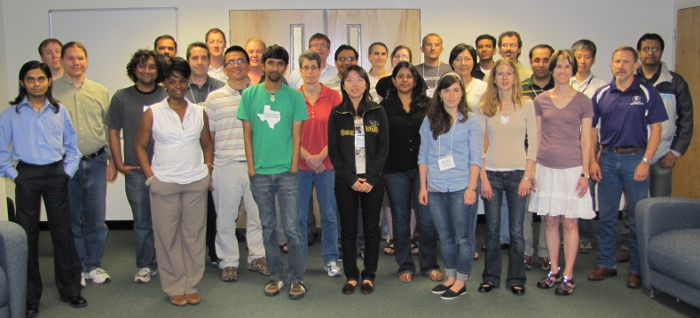
Topic: Migration from the Desktop: HPC application of R and other codes for biological research
Meeting dates: May 9-11, 2011
Location: NIMBioS at the University of Tennessee, Knoxville
Organizers:
• Contact: Eric Carr (HPC Specialist, NIMBioS, carr_at_nimbios.org)
• Michael Gilchrist (Ecology and Evolutionary Biology and NIMBioS, UTK)
• Jian Huang (Electrical Engineering and Computer Science and RDAV, UTK)
• Amy Szczepanski (Education, Outreach, and Training Coordinator, RDAV)
Invited speakers:
• William Godsoe (NIMBioS)
• Bob Muenchen (OIT-UTK)
• Pragnesh Patel (RDAV/NICS)
• Scott Simmerman (RDAV/NICS, EECS)
Objectives: As the number and size of available datasets continue to grow across all areas of biology, so do the computational resources required to analyze such datasets. Whether the researcher is a molecular or ecosystems biologist, questions that exceed the capabilities of desktop computers and that require the use of high performance computing (HPC) toolkits are now common. The goal of this workshop was to introduce participants to the skills, strategies, and techniques necessary for them to make the jump from desktop computing to HPC environments. The workshop included lectures, case-studies, hands-on labs, and small group discussions. The workshop began with the basics such as outlining the key differences between desktop computing and HPC, how to identify and access appropriate HPC resources, and choosing problems well-suited to the HPC environment. Visualization tools were introduced, as were topics in data management and best practices in development. Case studies, which are expected to include projects focused on sequence evolution, systems biology, and species distribution modeling, provided concrete examples of how the shift from desktop to HPC computing can be achieved. We presented ways of using non-parallel code, for example R functions, in an HPC environment as a way to take advantage of the historical computational resources of the biological community.
This tutorial was geared toward biologists (including students, postdocs and faculty) whose research has grown beyond what desktop computers can handle and require HPC to progress further. The tutorial provided information to identify appropriate high performance computing resources for their research, perform a parameter sweep, address data storage issues, and use some common HPC tools in data analysis and visualization.
Evaluation report (PDF)
Products
Publications
Velazquez J, Garrahan JP, Eichhorn MP. 2014. Spatial complementarity and the coexistence of species. PLoS ONE, 9(12): e114979. [Online]
Simmerman S, Wang J, Osborne J, Shook K, Huang J, Godsoe W, Simons T. 2012. Exploring similarities among many species distributions. Proceedings of the 1st Conference of the Extreme Science and Engineering Discovery Environment 2012: Bridging from the eXtreme to the campus and beyond, article no. 38. [Online]
Data/Software/Models
Velazquez J, Garrahan JP, Eichhorn MP. 2014. Data: IBM Ecology Simulator. [Online]
A goal of NIMBioS is to enhance the cadre of researchers capable of interdisciplinary efforts across mathematics and biology. As part of this goal, NIMBioS is committed to promoting diversity in all its activities. Diversity is considered in all its aspects, social and scientific, including gender, ethnicity, scientific field, career stage, geography and type of home institution. Questions regarding diversity issues should be directed to diversity@nimbios.org. You can read more about our Diversity Plan on our NIMBioS Policies web page. The NIMBioS building is fully handicapped accessible.
NIMBioS
1122 Volunteer Blvd., Suite 106
University of Tennessee
Knoxville,
TN 37996-3410
PH: (865) 974-9334
FAX: (865) 974-9461
Contact NIMBioS